High Protein Cottage Cheese Pizza Crust
A high protein cottage cheese pizza crust that’s crispy, cheesy, and surprisingly satisfying—perfect for pizza night without the carb crash.
I stumbled onto this recipe on a random Tuesday night when I was craving pizza but didn’t want the usual flour-heavy version weighing me down. I had cottage cheese in the fridge and thought, why not? Turns out, cottage cheese makes an incredibly tasty, protein-packed pizza base that actually crisps up in the oven. My family didn’t even realize it wasn’t traditional dough until I told them.
This high protein cottage cheese pizza crust has become my go-to for weeknight dinners when I want something filling but lighter. It’s got that cheesy, savory flavor baked right into the base, and it holds toppings like a champ.
Quick Answer: A high protein cottage cheese pizza crust is made by mixing cottage cheese with eggs, flour, and seasonings, then baking it into a firm, golden base before adding your favorite pizza toppings. It’s a fantastic low-carb, high-protein alternative to regular pizza dough that delivers about 20 grams of protein per serving.
Table of Contents
Why You’ll Love This High Protein Cottage Cheese Pizza Crust
This is just one of the many gems in our High-Protein Cottage Cheese Mains series. Every recipe there has been tested and loved in real kitchens, and I promise there’s something for every craving. Go see for yourself.
This isn’t one of those sad, cardboard-tasting healthy swaps. This cottage cheese pizza crust actually tastes good—like really good. The cottage cheese gives it a creamy, slightly tangy flavor that pairs perfectly with tomato sauce and melted cheese on top.
It’s ridiculously easy to throw together. No yeast, no waiting for dough to rise, no kneading. Just mix, spread, bake, and top. The whole thing comes together in under 40 minutes, which is faster than ordering delivery most nights.
The protein content is what really sets this apart. Each serving packs in a solid amount of protein thanks to the cottage cheese and eggs, making it way more satisfying than regular pizza. You won’t find yourself sneaking back to the kitchen an hour later looking for a snack.
Plus, it’s flexible. Use whatever flour you like—all-purpose, whole wheat, almond flour, or even a gluten-free blend. Top it however you want. It’s basically a blank canvas that happens to be packed with protein.

High Protein Cottage Cheese Pizza Crust
Ingredients
Ingredients
- 1 cup cottage cheese used low-fat, small curd
- 2 large eggs
- ¼ cup flour of your choice I used all-purpose
- 1 teaspoon onion powder
- 1 teaspoon Garlic powder
- ½ teaspoon Dried Oregano
- ½ cup Pizza sauce or marinara
- ¾ cup low-fat pizza Cheese blend or shredded mozzarella
- 2 ounces of Turkey Pepperoni
- 1 tablespoon grated parmesan optional to garnish
- Black pepper optional
Instructions
- Preheat the oven to 350 F and line a sheet pan with parchment paper.
- In a large bowl, add the 1 cup cottage cheese, 2 large eggs, 1/4 cup flour of your choice, 1 teaspoon onion powder, 1 teaspoon Garlic powder, and 1/2 teaspoon Dried Oregano. You may add a bit of Black pepper at this point.
- Using a spatula, stir to fully combine. No need to blend. You just need a smooth texture.
- Transfer the mixture onto the prepared sheet pan. Using a spoon or spatula, spread the cottage cheese mixture to form a circle. Do not spread it too thin.
- Bake for 25-30 minutes or until it is slightly golden brown. Remove from the oven and let it sit for 1-2 minutes.
- Spread the 1/2 cup Pizza sauce over the baked cottage cheese crust and top with 3/4 cup low-fat pizza Cheese blend.
- Add 2 ounces of Turkey Pepperoni and bake again for 5-7 minutes or until the cheese is fully melted. Garnish with 1 tablespoon grated parmesan or chili flakes. Enjoy.
Ingredients You’ll Need for Cottage Cheese Pizza Crust
The ingredient list is short and sweet. You probably have most of this stuff in your kitchen already, which is one of the reasons I make this recipe so often.

| Ingredient | Amount | Notes |
|---|---|---|
| Cottage cheese | 1 cup | Low-fat, small curd works best—gives a smoother texture |
| Large eggs | 2 | Helps bind everything together and adds protein |
| Flour | 1/4 cup | All-purpose, almond, or gluten-free—your choice |
| Onion powder | 1 teaspoon | Adds savory depth to the crust |
| Garlic powder | 1 teaspoon | Because garlic makes everything better |
| Dried oregano | 1/2 teaspoon | Classic pizza flavor right in the base |
| Pizza sauce | 1/2 cup | Or marinara—whatever you have on hand |
| Pizza cheese blend | 3/4 cup | Low-fat or regular mozzarella works great |
| Turkey pepperoni | 2 ounces | Or swap for veggies, sausage, whatever you like |
| Grated parmesan | 1 tablespoon | Optional garnish but highly recommended |
| Black pepper | To taste | Optional but adds a nice kick |
The cottage cheese is the star here. I use low-fat small curd because it blends more smoothly into the mixture, but full-fat works too if that’s what you have. The curds break down as you stir, so don’t worry if it looks lumpy at first.
Flour is the only thing holding this together, structure-wise. A quarter cup might not seem like much, but it’s enough to give the crust stability without turning it into regular dough. I’ve used almond flour when I’m going lower carb, and it works beautifully—just know the texture will be slightly more delicate.
The seasonings—onion powder, garlic powder, and oregano—are non-negotiable in my book. They turn the crust from bland to actually flavorful, so you’re not just eating a vehicle for toppings. You’re eating something that tastes good on its own.
Step-by-Step Instructions for Making High Protein Cottage Cheese Pizza Crust
This recipe is so straightforward, it almost feels like cheating. No fancy equipment, no complicated techniques—just mix, bake, top, and bake again. Here’s exactly how I do it every single time.

- Preheat your oven to 350°F and line a sheet pan with parchment paper. Don’t skip the parchment paper. Trust me on this. The crust can stick a bit without it, and parchment makes cleanup a breeze.
- Combine the cottage cheese, eggs, flour, onion powder, garlic powder, and oregano in a large bowl. I like to crack the eggs right in there and just go for it. Add a few cracks of black pepper if you’re feeling it.
- Stir everything together with a spatula until it’s fully combined. You’re looking for a smooth, thick batter—not quite pancake batter, but not dough either. The cottage cheese curds will mostly break down as you mix. No need to blend or use a mixer unless you really want to. I keep it simple and just stir by hand.
- Pour the mixture onto your prepared sheet pan and spread it into a circle. Use the back of a spoon or your spatula to shape it. I aim for about a 10-inch circle, maybe a quarter-inch thick. Don’t spread it too thin or it won’t hold up under the toppings. A little thickness gives you that satisfying bite.
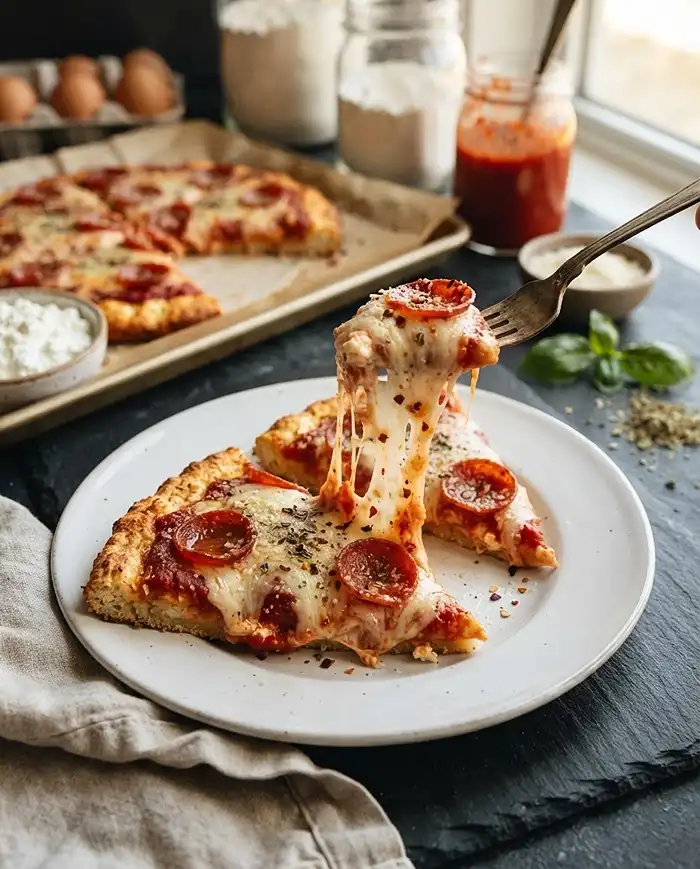
- Bake for 25 to 30 minutes, until the crust is slightly golden brown around the edges. You want it firm to the touch, not jiggly. The edges will get a little crispy and darker than the center, which is exactly what you want. When you pull it out, let it sit on the pan for a minute or two. It firms up as it cools slightly.
- Spread the pizza sauce over the baked crust. I use about half a cup, but you can adjust based on how saucy you like your pizza. Leave a little border around the edge for that classic pizza look.
- Sprinkle the cheese evenly over the sauce, then add your pepperoni. I use turkey pepperoni to keep it on the lighter side, but regular pepperoni is delicious too. Arrange it however makes you happy—I’m not judging your pepperoni placement strategy.
- Bake again for 5 to 7 minutes, just until the cheese is fully melted and bubbly. You’re not baking the crust anymore; you’re just melting the cheese and warming the toppings. Keep an eye on it so the edges don’t burn.
- Garnish with grated parmesan or chili flakes. The parmesan adds this lovely salty, umami kick that makes the whole thing taste more pizza-like. Let it cool for a minute, slice it up, and dig in.
The first time I made this, I was skeptical it would actually hold together. But once that crust bakes, it’s surprisingly sturdy. You can pick up a slice with your hands, though it’s a bit more delicate than traditional dough. Think of it as a thick, cheesy flatbread that happens to be high in protein.
Expert Tips for the Best Cottage Cheese Pizza Crust
Don’t skip the pre-bake. Baking the crust alone first is essential. If you add toppings right away, the crust stays soggy and won’t firm up properly. That initial bake is what creates structure.
Pat the cottage cheese dry if it’s really watery. Some brands have more liquid than others. If your cottage cheese looks like it’s swimming in whey, drain off the excess or give it a gentle pat with a paper towel. Too much moisture makes the crust take forever to firm up.
Season generously. The crust itself should taste good, not bland. I’ve made the mistake of going light on the garlic and onion powder, and it just tastes like eggs and cheese. The seasonings make it taste like pizza.
Let it cool for a minute after the first bake. It continues to firm up as it cools slightly. If you try to top it immediately, it might feel too soft and you’ll panic. Give it a minute. It’ll be fine.
Use a pizza cutter or sharp knife to slice. A dull knife will drag and tear the crust. A pizza cutter glides right through and gives you clean slices.
Add toppings sparingly. This isn’t a thick, chewy dough that can handle a mountain of toppings. Keep it reasonable—sauce, cheese, and a moderate amount of toppings. Overloading it will make it soggy and hard to eat.
Delicious Variations to Try
Veggie Lover’s Pizza: Skip the pepperoni and load it up with bell peppers, mushrooms, red onion, and spinach. Just make sure to cook any watery veggies like mushrooms first, or they’ll make the crust soggy.
BBQ Chicken: Swap the pizza sauce for BBQ sauce, add shredded cooked chicken, red onion, and cilantro after baking. It’s a total crowd-pleaser and feels fancy even though it’s stupid easy.
White Pizza: Skip the tomato sauce entirely. Brush the crust with a little olive oil, then top with ricotta, mozzarella, garlic, and spinach. Add a drizzle of balsamic glaze after baking if you’re feeling extra.
Margherita Style: Keep it simple with fresh mozzarella, sliced tomatoes, and fresh basil. This one really lets the flavor of the cottage cheese crust shine through.
Keto-Friendly Version: Use almond flour instead of all-purpose and keep your toppings low-carb. The crust itself is already pretty low in carbs, but swapping the flour takes it even lower.
Spicy Version: Add red pepper flakes to the crust mixture, use spicy marinara, and top with jalapeños or hot Italian sausage. Perfect if you like a little heat with your pizza.
I’ve tried most of these variations, and honestly, they all work. This crust is like a blank slate that just wants you to get creative. If you’re looking for more cottage cheese recipes, you might also love this high protein cottage cheese chicken salad or these spinach cottage cheese oat pancakes.
Troubleshooting Common Issues
My crust is too soft and won’t hold together. You probably didn’t bake it long enough, or your cottage cheese was too watery. Make sure the crust is golden and firm before adding toppings. If your cottage cheese is really liquidy, drain it first or add an extra tablespoon of flour to the mixture.
The crust tastes too eggy. This usually means not enough seasoning. The garlic powder, onion powder, and oregano are there to balance out the egg flavor. Don’t be shy with them. Also, make sure you’re using cottage cheese and not just eggs with a little cheese—the ratio matters.
The edges are burning but the center is still pale. Your oven might run hot, or you spread the crust unevenly. Try lowering the temperature to 325°F and baking a bit longer. Also, make sure the crust is an even thickness all the way across.
The toppings are sliding off. You might’ve added too much sauce or overloaded the toppings. Keep the sauce layer thin and don’t pile on too much cheese or other toppings. This crust is sturdy, but it’s not indestructible.
It’s sticking to the pan. Always use parchment paper. Always. I learned this the hard way and spent 20 minutes scraping stuck crust off a baking sheet. Don’t be like me.
The crust is too thick and doughy in the middle. You spread it too thick. Aim for about a quarter-inch thickness. If it’s thicker than that, it won’t cook through properly and will stay soft and dense in the center.
How to Store High Protein Cottage Cheese Pizza Crust
Leftovers keep surprisingly well, which is great because I usually make extra. The crust holds up in the fridge without getting too soggy, and you can even freeze it if you want to meal prep.
| Storage Method | Duration | Best Practices |
|---|---|---|
| Room Temperature | Not recommended | The cottage cheese and eggs make this perishable—refrigerate it |
| Refrigerator | 3-4 days | Store in an airtight container; reheat in the oven for best texture |
| Freezer | Up to 2 months | Wrap slices individually in plastic wrap, then foil; thaw overnight in fridge |
To reheat, I always use the oven or toaster oven. Pop it in at 350°F for about 8 to 10 minutes, until the cheese is bubbly again and the crust crisps back up. The microwave works in a pinch, but it makes the crust a bit rubbery. If you do microwave it, put it on a paper towel to absorb some moisture, and don’t overcook it.
If you’re meal prepping, you can bake just the crust, let it cool completely, then wrap it tightly and refrigerate or freeze. When you’re ready to eat, add your toppings and bake. It’s like having homemade frozen pizza, but way healthier.
According to the USDA guidelines on leftovers, any dish containing eggs and dairy should be refrigerated within two hours and eaten within three to four days, so plan accordingly.
High Protein Cottage Cheese Pizza Crust FAQs
How do you make a high protein cottage cheese pizza crust?
To make a high protein cottage cheese pizza crust, blend cottage cheese until smooth, then mix it with eggs, mozzarella cheese, and a small amount of flour or almond flour. Season with garlic powder, Italian herbs, and salt. Spread the mixture thinly on a lined baking sheet and bake at 375-400°F until golden and firm, about 20-25 minutes. Let it cool slightly before adding toppings.
How much protein is in cottage cheese pizza crust compared to regular pizza crust?
A cottage cheese pizza crust typically contains 15-25 grams of protein per serving, depending on the recipe and portion size. This is significantly higher than traditional pizza crust made from white flour, which usually contains only 4-6 grams of protein per serving. The high protein content comes from the cottage cheese and eggs used as the base ingredients.
Does cottage cheese pizza crust taste like cottage cheese?
No, cottage cheese pizza crust does not have a strong cottage cheese flavor. When baked, the cottage cheese becomes mild and neutral, especially when combined with seasonings like garlic, herbs, and cheese. The final taste is more similar to a cheesy flatbread or traditional pizza crust, making it an enjoyable option even for those who might not typically eat cottage cheese on its own.
Is cottage cheese pizza crust gluten-free?
Cottage cheese pizza crust can be made gluten-free by using almond flour, coconut flour, or other gluten-free flour alternatives instead of regular wheat flour. Some recipes use no flour at all, relying only on cottage cheese, eggs, and cheese to bind the crust together. Always check your specific recipe and ingredient labels to ensure all components are certified gluten-free if you have celiac disease or gluten sensitivity.
How do you prevent cottage cheese pizza crust from being soggy?
To prevent a soggy cottage cheese pizza crust, make sure to blend the cottage cheese well to remove excess liquid, and consider draining it through cheesecloth if it seems very wet. Bake the crust fully before adding toppings, allowing it to become golden and firm. Use a thin layer of sauce and avoid overloading with wet toppings. Pre-cooking vegetables to remove moisture and using low-moisture mozzarella also helps keep the crust crispy.
Final Thoughts on This Cottage Cheese Pizza Crust Recipe
This high protein cottage cheese pizza crust has honestly changed my pizza game. It’s one of those recipes that feels a little too easy to be as good as it is, but here we are. It’s quick, it’s satisfying, and it doesn’t leave me feeling like I need a nap after eating it.
If you’re trying to add more protein to your diet, cutting back on carbs, or just looking for a fun new way to make pizza, give this a shot. It’s not trying to be traditional pizza dough, and that’s exactly why it works. It’s its own thing, and it’s delicious.
Once you nail the basic technique, you can customize it however you want. I’ve made this at least a dozen times now, and I’m still finding new topping combinations I love. If you’re into cottage cheese recipes, you’ll probably also enjoy this 2-ingredient protein cheesecake or this cottage cheese chocolate chip cookie dough—both are high protein and surprisingly delicious.
Give this recipe a try and let me know how it turns out for you. What toppings did you use? Did you make any fun variations? I’d love to hear about it. Happy pizza making!